
Can a Marriage Really Recover From an Affair?
Nov 03, 2026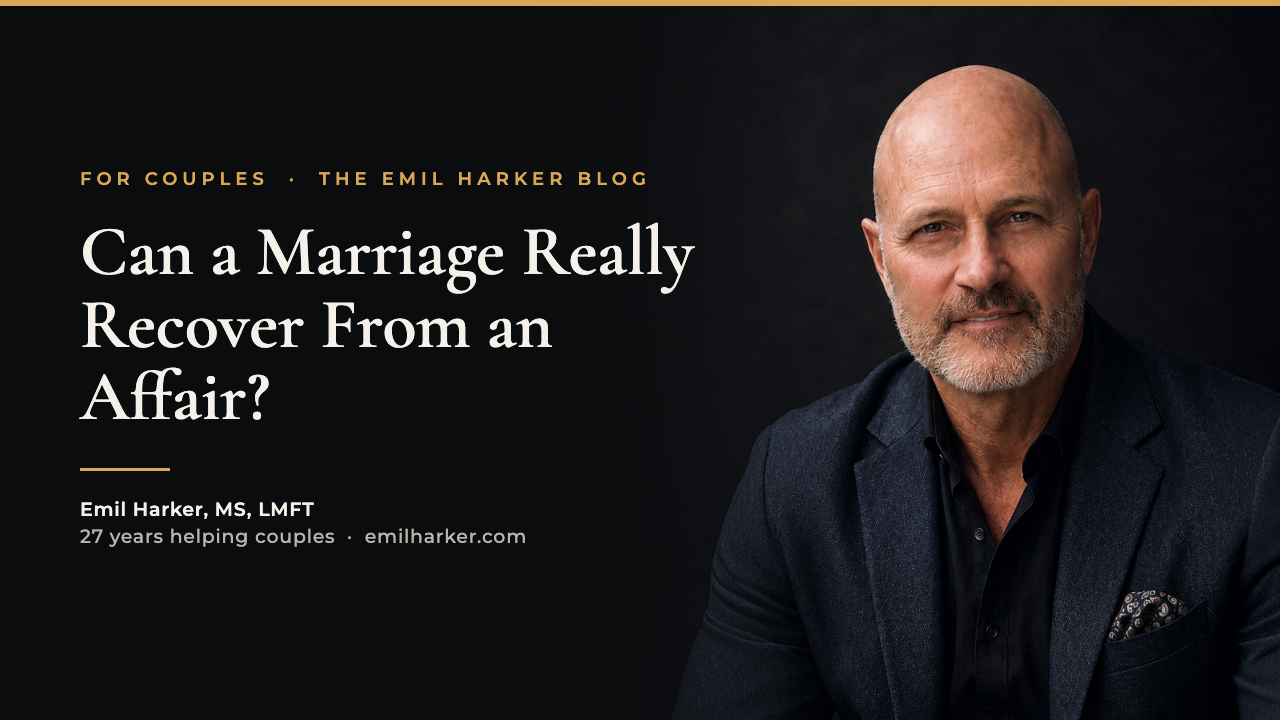
By Emil Harker, MS, LMFT · Licensed Marriage and Family Therapist · 27 years helping couples
Short answer: yes, many marriages do recover from an affair. Some even end up stronger than they were before. But recovery doesn't happen because time passes or because someone says sorry enough times. It happens when both people do specific, hard work, in the right order. And it takes longer than either of you wants it to.
The night everything changed
Dan and Rachel sat on opposite ends of my couch. (They're a composite of couples I've worked with, with the details changed.) Three weeks earlier, Rachel had found the messages.
Dan wanted to move on. “I ended it. I said I'm sorry. I don't know what else she wants from me.” Rachel wanted answers, and she wanted them at 2 a.m., every night. “How can he expect me to just get over it? I don't even know who I'm married to.”
Both of them were hurting. And both of them were stuck, because they were each trying to heal on a different clock.
Why it hurts this much
The first step toward healing is what I call Defining and Accepting Reality: seeing what is actually true, not what we wish were true. Here's the reality after an affair.
- It isn't just about sex or another person. For the hurt partner, an important part of the betrayal is the deception and dishonesty surrounding it. The story they believed about their own life turned out not to be true. They stop believing that they can trust their own feelings.
- Their brain is on high alert. The questions, the checking, the 2 a.m. conversations aren't drama. That's a nervous system trying to make sure it never gets blindsided again.
- Triggers are everywhere. A song, a restaurant, a phone face-down on the counter. I call these landmines. Stepping on one can send the hurt partner right back to the day they found out.
- The partner who strayed is often drowning in shame. Shame makes people defensive, impatient and quick to say “Can we please stop talking about this?” That feels like self-protection. To the hurt partner, it feels like a second betrayal.
I'll be honest: I see couples get this backwards all the time. The person who had the affair wants it over. The person who was betrayed wants answers.
The path back, in order
Marriage researcher Dr. John Gottman describes affair recovery in three phases: atone, attune and attach. That fits what I see in my office. Here's what each phase asks of each of you.
1. Atone: stop the bleeding
If you had the affair:
- End it completely. No “closure” conversations, no staying friends.
- Answer questions honestly, even the ones you dread. Trickle-truth, where the story comes out in pieces, re-injures the wound every time.
- Offer transparency before you're asked: phone, passwords, where you are.
- Own it without a “but.” “I didn't have the courage to bring up issues I needed to, and I was selfish in focusing on what I wanted to feel instead of how it would make you feel." “I did it because you were never around” doesn't.
If you were betrayed:
- It's going to hurt. It's O.K. that you feel it. But it will go away sooner than you think. You don't have to be fine yet.
- Get support that is yours alone: a therapist, or one or two trusted friends.
- Hold off on big, permanent decisions in the first weeks, if you safely can. If you need a week or two of separation ask for it. It can be confusing and painful when you want comfort from the one who hurt you. Ugh!
2. Attune: understand what happened
Once the crisis calms down, it's time to understand how the marriage got to a place where an affair could happen. The betrayer needs to understand deeply how they were making small choices supported by rationalization, justification, and minimization. If they don't understand how they were able to betray, there is no way to make a commitment to not do it again. Plus, the path forward needs to be clear enough to create confidence in the person who was betrayed. For recovery, both people need to see their role in the relationship that wasn't as fulfilling as it needed to be. The affair was a choice, and it belongs to the person who made it. But most affairs grow in soil that both people tended: distance, resentment, avoided conflict, needs never spoken. Looking at that soil together is how you make sure nothing grows there again.
This is also where Communicating with the Desired Outcome in Mind matters most. Before a hard conversation, ask yourself how you want your spouse to feel when it's over. Then speak in a way that makes that possible. This won't come natural, I suggest getting my book "You Can Turn Conflict Into Closeness" endorsed by Dr. John Gottman. You will want the tools and the skills so you can get through these hard conversations better.
3. Attach: build a new marriage
You're not going back to the old marriage. That marriage had a crack in it. You're building a new one, on purpose: new rituals of connection, new ways to handle conflict, and, slowly, a new kind of physical closeness. This is the work I call The Deliberate Marriage, choosing your relationship by design instead of by default.
What happened with Dan and Rachel
The turning point came when Dan stopped asking Rachel to get over it, and started asking what she needed to feel safe. He answered her questions without sighing. He handed her his phone before she asked. Months later, Rachel told me, “I don't trust him because he says he's changed. I trust him because he's been showing me, every day, for a long time.”
The honest truth
I don't want to burst your bubble: not every marriage survives an affair. It takes two people willing to do the work. If the affair is still going on, if the lying hasn't stopped, or if there is abuse or control in the relationship, the first priority is safety, not saving the marriage.
But when both people commit, I've watched many couples build something more honest and fulfilling than what they had before.
Frequently asked questions
How long does it take to recover from an affair?
I honestly don't like this question, because there isn't a time frame. Even in the midst of the first few weeks, when there is true remorse and change of heart, closeness starts building. With appropriate effort, and openness connection builds quickly. But within a few months most people are surprised by how much better they feel.
Should I tell the kids?
Usually not the details. Talk with a therapist about what is age-appropriate before you say anything.
Do I have to forgive to stay married?
Forgiveness is a process, not a moment. You don't have to feel it on day one. It usually grows as trust is rebuilt. Forgiveness also doesn't mean staying. Sometimes forgiveness includes divorce.
Can we do this without counseling?
Sure, it's possible. But affair recovery is one of the hardest things a marriage can face. Even a persons best intentions usually backfires in these situations. A trained therapist helps you avoid making it worse and helping you get back on track a lot sooner.
Try this this week
- If you had the affair: offer one act of transparency your spouse didn't have to ask for.
- If you were betrayed: write down your three biggest unanswered questions. Decide with your spouse, or with a therapist, when to talk about them, instead of at 2 a.m.
- Both of you: name one landmine (a place, a song, a time of day) and decide how you want to respond differently. (Don't be controlled by the memory or fears of the betrayal.)
Where to start
If you're in Utah, I work with couples recovering from affairs, in person in Layton and online. For couples anywhere, The Deliberate Marriage program walks you through rebuilding step by step. The communication principles behind it are in my book, You Can Turn Conflict Into Closeness. You might also read My Wife Says She's Done. Is It Too Late?
About the author: Emil Harker, MS, LMFT, is a licensed marriage and family therapist in Layton, Utah (license #317686-3902), with 27 years of experience helping couples through betrayal, conflict and disconnection. He's the author of You Can Turn Conflict Into Closeness and Confidence In Conflict, and the host of The Emil Show podcast.
Stay connected with news and updates!
Join our mailing list to receive the latest news and updates from our team.
Don't worry, your information will not be shared.
We hate SPAM. We will never sell your information, for any reason.
